
Why We Should Never Stop Learning | The Value of Curiosity
Discover why lifelong learning and curiosity make life richer, more interesting, and more meaningful—one small discovery at a time.
CURIOSITY
Ela Urbanowicz
2 min read
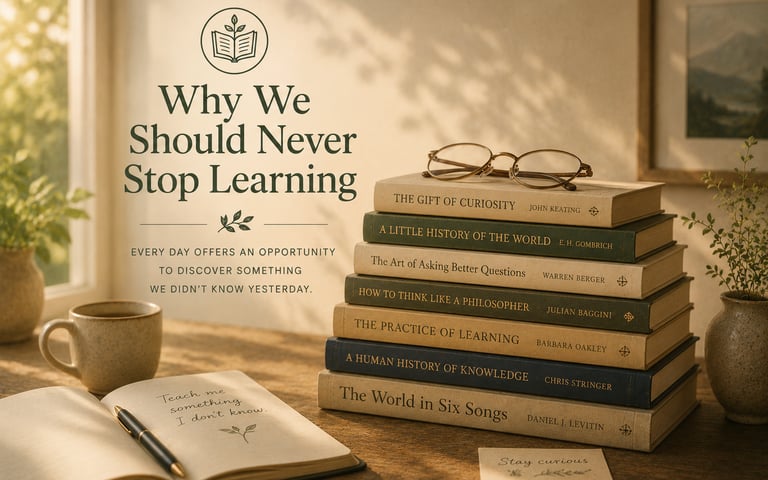
One of my favourite things to say is: "Teach me something I don't know."
Whenever someone shares a fact, a skill, a story, or a different way of seeing the world, I feel like I've gained something valuable. It doesn't have to be life-changing or very useful. It simply has to be new.
And that is one of the reasons I believe we should never stop learning.
Learning Is More Than School
When we hear the word "learning," many of us think about classrooms, exams, and textbooks. Yet some of the most meaningful learning happens long after our formal education ends. It happens through conversations, books, travel, work, mistakes, questions, and simple curiosity.
Learning is not something we finish. It is something we continue.
Every day offers an opportunity to discover something we didn't know yesterday.
Every Person Knows Something You Don't
One of the things I enjoy most about meeting people is that everyone carries knowledge I don't have. A colleague might teach me a shortcut, a friend might recommend a book, a child might ask a question I have never considered, and someone on the other side of the world might live in a completely different way.
Every person sees the world through a unique lens; if we stay curious, every conversation becomes an opportunity to learn.
The moment we believe we already know enough, we stop noticing how much there is still left to discover.
Curiosity Makes Life Richer
Learning is not only about becoming more knowledgeable. It is about becoming more interested.
A curious person sees possibilities everywhere. A walk becomes an opportunity to notice something new. A book becomes a doorway to another perspective. A conversation becomes a chance to understand someone better. The world becomes larger because curiosity keeps expanding it.
The opposite is also true. When curiosity fades, the world can begin to feel smaller and more predictable.
Small Discoveries Matter
We often celebrate major achievements. A degree, a qualification, a promotion. Yet learning is not only made up of big milestones; sometimes it is a single fact, a new word, an interesting observation, a different perspective.
These small discoveries may seem insignificant on their own but over time, they accumulate.
A curious life is built one small discovery at a time.
The Joy of Not Knowing
There is a certain freedom in admitting that we don't know everything. In fact, not knowing can be exciting. It means there is still more to explore. More questions to ask, more books to read, more people to meet, more ideas to discover.
The moment we stop pretending to know everything, learning becomes enjoyable again.
The Quick Read Moments Philosophy
Curiosity is one of the pillars of Quick Read Moments. Not because knowledge makes us better than others, but because curiosity makes life more interesting.
Every book contains ideas we haven't encountered, every conversation contains perspectives we haven't considered.
Every day contains something we can learn. We don't need to become experts in everything.
We simply need to remain open, because the world is full of things we don't know yet.
And that is one of the most wonderful things about it.
Part of the Quick Read Moments Philosophy
This article belongs to the Curiosity pillar of the Quick Read Moments philosophy.